

Stack in Java
Stack extends Vector with five operations that allow a vector to be treated as a stack. It supports last-in, first-out (LIFO) operations.
July 7, 2024 · 7 min read · Updated Sep 2025
Stack extends Vector with five operations that allow a vector to be treated as a stack. It supports last-in, first-out (LIFO) operations.
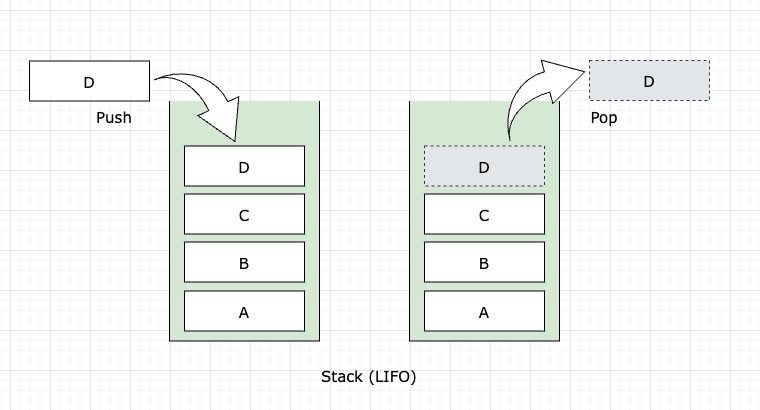
Stack allows the following operations:
- push(item): Adds an item to the top of the stack.
- pop(): Removes and returns the item at the top of the stack.
- peek(): Returns the item at the top of the stack without removing it.
- empty(): Checks if the stack is empty.
- search(item): Locates the presence of an item in the stack and it returns the distance from the top. If there are duplicate items it returns the top most occurrence.
As the Stack extends Vector, all the stack operations are synchronized and thread-safe — and it inherits Vector's doubling growth strategy and non-fail-fast Enumeration, covered in the Vector article.
One detail worth knowing: push() and pop() operate on the end of the underlying array, not the beginning. push() is really just addElement(), and pop() removes the last element — so both are O(1) amortized, not O(n). If push/pop worked at index 0 instead, every operation would require shifting the entire array.
search(item) returns a 1-based distance from the top, not a zero-based index — search() returning 1 means "the top element," not "index 1."
Take a text editor's undo/redo feature as an example — you need to track every typing action in order, and a Stack is a natural fit for that.
public class TextEditor {
    private final Stack<String> textStack = new Stack<>();
    private final Stack<String> undoStack = new Stack<>();

    public void type(String text) {
        textStack.push(text);
        undoStack.clear();
    }

    public void undo() {
        if (!textStack.isEmpty()) {
            String lastText = textStack.pop();
            undoStack.push(lastText);
        } else {
            System.out.println("Nothing to undo.");
        }
    }

    public void redo() {
        if (!undoStack.isEmpty()) {
            String lastUndoText = undoStack.pop();
            textStack.push(lastUndoText);
        } else {
            System.out.println("Nothing to redo.");
        }
    }

    public void display() {
        System.out.println("Current Text: " + String.join("", textStack));
    }

    public static void main(String[] args) {
        TextEditor editor = new TextEditor();
        editor.type("Hello, ");
        editor.type("world!");
        editor.display();

        editor.undo();
        editor.display();

        editor.redo();
        editor.display();

        editor.undo();
        editor.undo();
        editor.display();

        editor.redo();
        editor.display();
    }
}Why the JDK Recommends Against Stack
The Stack Javadoc says outright: prefer Deque for LIFO operations, implemented by ArrayDeque. Two reasons:
Stack extends Vector, which means it inheritsVector's entireListAPI. Nothing stops you from callingstack.add(0, item)orstack.remove(0)on aStackand silently breaking the LIFO ordering the class exists to enforce — the type system won't catch it.StackinheritsVector's synchronized-on-every-method behaviour and doubling growth strategy, both of which cost you in the (far more common) single-threaded case where you don't need the synchronization at all.
ArrayDeque doesn't have either problem: it isn't a List, so it can't expose operations that would break stack semantics, and it's unsynchronized by default with array-backed storage that resizes more efficiently. The textStack/undoStack fields in the example above translate directly:
private final Deque<String> textStack = new ArrayDeque<>();
private final Deque<String> undoStack = new ArrayDeque<>();
// push(), pop(), isEmpty() are all the same method names on DequeThe only thing you lose is search() — Deque has no equivalent, since finding an item's position isn't really a stack operation to begin with.