

LinkedList in Java
LinkedList uses a doubly linked list to store elements and it implements both the List and Queue interfaces.
July 7, 2024 · 17 min read · Updated Sep 2025
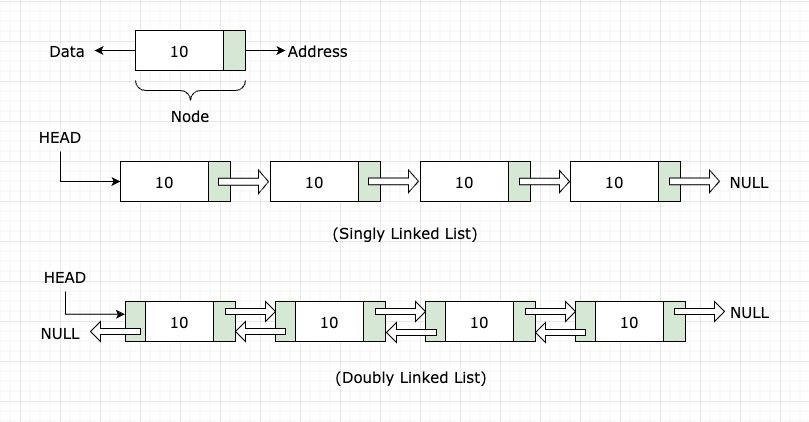
While an ArrayList uses a normal array to store elements, a LinkedList uses a doubly linked list to store elements. It implements both the List and Queue interfaces.
Key Properties of LinkedList
Each element inside a LinkedList is called a node. A node holds the data along with references to both the previous and next node — that's what makes it doubly linked.
LinkedList is preferred when the list size is unknown beforehand and the ability to grow or shrink dynamically is important.
The LinkedList in Java is not synchronized by default. If multiple threads attempt to modify a LinkedList concurrently, it must be synchronized externally to prevent unexpected behaviour.
"Fast middle inserts" is a half-truth
A common claim is that LinkedList is efficient for inserting or removing in the middle. That's only true if you already hold a ListIterator positioned at that spot — the actual splice is O(1). But linkedList.add(index, value) and linkedList.remove(index) still have to walk the list node by node to find that index first, which is O(n). LinkedList does optimize the walk itself — node(index) traverses from the head if index < size / 2, and from the tail otherwise — but that only halves the constant, it doesn't change the complexity.
In practice, get(index) is also O(n) for the same reason, which rules LinkedList out for anything that needs random access.
Memory cost
Each element costs more than it looks like it should. Where ArrayList stores a bare reference per slot in a contiguous array, every LinkedList element is wrapped in its own Node object holding the value plus prev/next references — roughly 3–4x the memory per element once you count object headers. That overhead, plus the poor cache locality of chasing pointers scattered across the heap, is why LinkedList tends to lose real-world benchmarks against ArrayList and ArrayDeque even in scenarios that look like its strong suit on paper.
Creating and Initialising LinkedList
Let us look at how we create and add elements to LinkedList.
// Creating LinkedList using the default constructor
List<String> linkedList = new LinkedList<>();
linkedList.add("Apple");
linkedList.add("Banana");
linkedList.add("Orange");

// Adding elements at a specific position
linkedList.add(1, "Guava");

// Adding elements to the beginning
linkedList.addFirst("Orange");

// Adding an element to the end
linkedList.addLast("Orange");

// Using ListIterator to add items to a specific position
ListIterator<String> iterator = linkedList.listIterator();
iterator.next();
iterator.add("Banana");// Creating a LinkedList from another collection
List<String> arrayList = Arrays.asList("Apple", "Banana", "Orange");
List<String> linkedListFromCollection = new LinkedList<>(arrayList);
// Using the offer method
Queue<String> queue = new LinkedList<>();
queue.offer("Apple");
queue.offer("Banana");
queue.offer("Orange");- The
add()method inserts elements at the end of the list. - The
offer()methods come from theDequeinterface and can be used to add elements to aLinkedList. They returntrueif the element was added successfully, andfalseotherwise.
Iterate over a LinkedList
// Using a For-Each Loop
for (String fruit: linkedList) {
    System.out.println(fruit);
}

// Using a Traditional For Loop
for (int i = 0; i < linkedList.size(); i++) {
    System.out.println(linkedList.get(i));
}

//Using an Iterator
Iterator<String> iterator = linkedList.iterator();
while (iterator.hasNext()) {
    System.out.println(iterator.next());
}

//Using a ListIterator
ListIterator<String> listIterator = linkedList.listIterator();
while (listIterator.hasNext()) {
    System.out.println(listIterator.next());
}

// Backward iteration
while (listIterator.hasPrevious()) {
    System.out.println(listIterator.previous());
}

// Using Java 8 Stream API forEach method
linkedList.forEach(fruit -> System.out.println(fruit));

// Using Java 8 Stream API streams
linkedList.stream().forEach(fruit -> System.out.println(fruit));Removing an Item in a LinkedList
// Removes the element at index 1 (Banana)
linkedList.remove(1);

// Removes the first occurrence of "Banana"
linkedList.remove("Banana");

// Removes the first element (Apple)
linkedList.removeFirst();

// Removes the last element (Orange)
linkedList.removeLast();

// Removing All Occurrences of a Collection
List<String> itemsToRemove = Arrays.asList("Banana", "Orange");
linkedList.removeAll(itemsToRemove);

// Remove elements based on a condition
linkedList.removeIf(fruit -> fruit.startsWith("B"));

// Removes all elements from the list
linkedList.clear();Get the size of a LinkedList
linkedList.size();Check if an item exists in a LinkedList
linkedList.contains("Banana");Example
Here's a simple playlist built on LinkedList where we can add, remove, and display songs.
public record Song(String title, String artist) {
}

public class MusicPlaylist {
    private final LinkedList<Song> playlist;

    public MusicPlaylist() {
        playlist = new LinkedList<>();
    }

    public void addSong(Song song) {
        playlist.add(song);
    }

    public void removeSong(Song song) {
        playlist.remove(song);
    }

    public void displayPlaylist() {
        for (int i = 0; i < playlist.size(); i++) {
            System.out.println((i + 1) + ". " + playlist.get(i));
        }
    }

    public static void main(String[] args) {
        MusicPlaylist myPlaylist = new MusicPlaylist();

        Song song1 = new Song("Bohemian Rhapsody", "Queen");
        Song song2 = new Song("Imagine", "John Lennon");
        Song song3 = new Song("Hotel California", "Eagles");

        myPlaylist.addSong(song1);
        myPlaylist.addSong(song2);
        myPlaylist.addSong(song3);

        System.out.println("My Playlist:");
        myPlaylist.displayPlaylist();

        System.out.println("Removing 'Imagine' from playlist.");
        myPlaylist.removeSong(song2);

        System.out.println("Updated Playlist:");
        myPlaylist.displayPlaylist();
    }
}Iterating and removing safely
LinkedList's iterator is fail-fast, same as ArrayList — it tracks modCount and throws ConcurrentModificationException if you mutate the list through anything other than the iterator itself while iterating. Use Iterator.remove(), listIterator().remove(), or removeIf() instead of calling linkedList.remove(...) inside a for-each loop.
LinkedList vs the Alternatives
- vs
ArrayList:ArrayListbeatsLinkedListon nearly every practical metric — cache locality, memory per element, and O(1) indexed access.LinkedList's theoretical edge (O(1) splice) only materializes when you're already holding aListIteratorat the insertion point. - vs
ArrayDeque: if you're usingLinkedListpurely as aQueueorDeque(viaoffer/poll/push/pop),ArrayDequeis faster and lighter for that same job — no per-node allocation, better cache behaviour, and the JDK documentation explicitly recommends it overLinkedListfor that use case.LinkedListonly wins if you specifically neednullelements, whichArrayDequedisallows.